
Non-Chemical vs Traditional Weed Control: 2026 Effectiveness Guide
Non-chemical weed control methods are highly effective for prevention and low-density infestations, but they often lack the immediate, broad-spectrum speed of traditional herbicides. For homeowners seeking a balanced approach, combining physical and biological strategies with targeted, naturally occurring treatments yields the best long-term results. This guide explores the science behind these methods, how to build an integrated system, and how Kick-Ass Grass applies these principles to deliver a guaranteed green lawn. For additional details, review the .
The Reality of Herbicide Resistance
Herbicide resistance is the evolutionary adaptation of a weed population that allows it to survive the application of a specific chemical compound. This phenomenon has become a critical challenge in modern lawn care, particularly as many landscape maintenance professionals have historically grown reliant on a single class of herbicides, such as glyphosate, for broad-spectrum control. When weeds evolve to withstand these chemicals, the efficacy of traditional treatments drops significantly, forcing growers and homeowners to seek alternative strategies. For additional details, review the Frequently Asked Questions.
Why Resistance Develops
Resistance typically emerges when a single chemical is used repeatedly without rotation or complementary management practices. This creates a strong selection pressure, allowing only the resistant individuals to survive and reproduce. Over time, the entire weed population becomes tolerant to the herbicide. This is not a failure of the product itself, but a biological inevitability when management is too narrow in scope. For additional details, review the About.
The Limitations of Sole Reliance
While herbicides remain the primary weed management method for many processing vegetable growers and residential lawns, shifting consumer preferences and environmental concerns are driving interest in more diverse approaches. Relying solely on chemical intervention ignores the ecological dynamics that allow weeds to thrive. A robust lawn care strategy must account for the fact that weeds are not static targets; they are adaptive organisms that will eventually outmaneuver a static chemical defense.
Building an Integrated Weed Management System
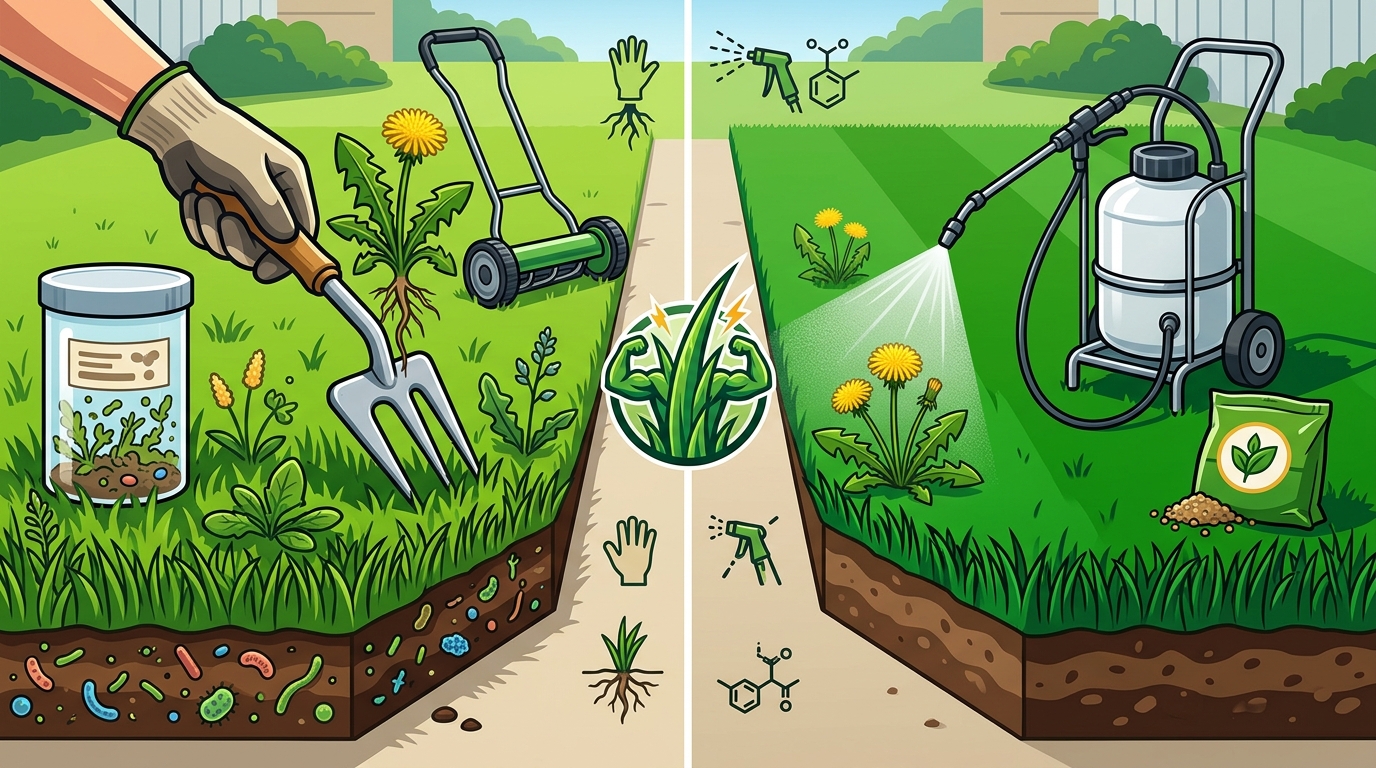
Integrated weed management (IWM) is a holistic strategy that combines multiple control methods to suppress weeds while minimizing the risk of resistance and environmental impact. Rather than viewing non-chemical and chemical methods as mutually exclusive, IWM treats them as complementary tools in a single toolkit. This approach is particularly effective for residential lawns where long-term health and aesthetics are the primary goals.
The Role of Cover Crops and Soil Health
Soil health is the foundation of any successful weed control program. In agricultural settings, research has shown that species mixtures in cover crops were not more effective in weed suppression compared to monoculture cover crops in some regions, such as Atlantic Canada. However, the principle remains that a dense, healthy turfgrass canopy is the most effective non-chemical barrier against weed establishment. By prioritizing soil aeration and proper fertilization, you create an environment where desirable grasses outcompete weeds for light and nutrients. according to Safer Non Selective
Physical and Mechanical Controls
Physical methods, such as mowing, aeration, and hand-pulling, are the backbone of non-chemical control. Mowing prevents weeds from setting seed, while aeration reduces soil compaction, allowing turfgrass roots to penetrate deeper and compete more effectively. These methods are labor-intensive but highly effective when applied consistently. They also avoid the chemical load that can accumulate in the soil over time.
Targeted Chemical Application
When chemical intervention is necessary, it should be targeted and precise. Kick-Ass Grass utilizes naturally occurring chemicals that are found in all organic living and growing things, including humans and trees. This approach ensures that the treatment is effective without introducing synthetic compounds that may drive rapid resistance. By using these targeted applications only when a specific problem is identified, we minimize the overall chemical footprint while maintaining a pristine lawn.
Method Comparison: Chemical vs Non-Chemical
Understanding the strengths and weaknesses of each method allows homeowners to make informed decisions about their lawn care regimen. The following table summarizes the key differences between traditional chemical herbicides and non-chemical control methods.
| Feature | Traditional Chemical Herbicides | Non-Chemical Methods | Integrated Approach |
|---|---|---|---|
| Speed of Action | Fast (days to weeks) | Slow (weeks to months) | Moderate (balanced) |
| Resistance Risk | High if used exclusively | None | Low (due to rotation) |
| Environmental Impact | Potential runoff and soil alteration | Minimal | Reduced |
| Cost | Variable (product + labor) | High labor cost | Optimized over time |
| Best For | Severe infestations | Prevention and maintenance | Long-term lawn health |
The data suggests that while herbicides are more effective at lower weed densities, they are not a standalone solution. In row annual weed density, ridge plant systems can reduce weed density nearly 80 percent compared to mulch-till systems, highlighting the power of physical and biological suppression. This statistic underscores the importance of combining methods to achieve the best results.
Key Takeaways
- Herbicide resistance is a biological reality that makes sole reliance on chemical treatments unsustainable over time.
- Integrated weed management combines physical, biological, and targeted chemical methods for superior long-term results.
- Non-chemical methods like mowing and aeration are highly effective for prevention but slower for existing infestations.
- Soil health and turf density are the most critical factors in natural weed suppression.
- Targeted use of naturally occurring chemicals can provide effective control without driving rapid resistance.
- Consumer preferences are shifting toward more sustainable and transparent lawn care practices.
- A professional service like Kick-Ass Grass can help you navigate the balance between chemical and non-chemical methods.
- Consistency is key; sporadic application of any method is less effective than a regular, integrated routine.
Frequently Asked Questions
Are non-chemical weed control methods completely safe for pets and children?
Yes, non-chemical methods such as mowing, aeration, and hand-pulling are generally considered safe for pets and children. They do not introduce any chemical residues into the environment. However, it is always a good idea to allow any treated area to dry completely before allowing pets or children to play on it, just as a precaution.
How long does it take for non-chemical methods to show results?
Non-chemical methods typically take longer to show visible results compared to chemical herbicides. You may see improvements in weed density within a few weeks, but full suppression can take several months. This is because these methods work by preventing weed reproduction and strengthening the turfgrass, rather than killing existing weeds immediately.
Can I use non-chemical methods in a heavily weeded lawn?
While non-chemical methods are effective for prevention, they may not be sufficient for a heavily weeded lawn. In such cases, a combination of targeted chemical treatment and non-chemical maintenance is usually recommended. This approach quickly reduces the weed load while building the foundation for long-term natural suppression.
What is the role of aeration in weed control?
Aeration helps weed control by reducing soil compaction and improving air, water, and nutrient flow to the turfgrass roots. A healthy, dense turfgrass is better able to compete with weeds for resources. Aeration also creates small holes in the soil, which can be used to apply targeted treatments more effectively.
Do non-chemical methods work for all types of weeds?
No, non-chemical methods are not equally effective for all types of weeds. Some weeds, such as dandelions, are easier to remove by hand, while others, like crabgrass, are more difficult to control without chemical intervention. The effectiveness of non-chemical methods depends on the specific weed species and the overall health of the lawn.
How often should I mow to control weeds?
Mowing frequency depends on the growth rate of your turfgrass and the weeds present. Generally, mowing when the grass reaches one-third of its desired height is recommended. This prevents weeds from setting seed and helps maintain a dense turfgrass canopy. Adjust your mowing frequency based on the season and weather conditions. according to The Potential of
Is it worth hiring a professional for integrated weed management?
Hiring a professional can be worth it if you want a guaranteed result and lack the time or expertise to manage your lawn yourself. Professionals like Kick-Ass Grass have the knowledge and tools to implement an integrated weed management system effectively. They can identify specific weed problems and apply the right combination of methods to achieve the best results.
What is the difference between selective and non-selective herbicides?
Selective herbicides are designed to kill specific types of weeds without harming the turfgrass, while non-selective herbicides kill all vegetation they come into contact with. In an integrated approach, selective herbicides are often preferred for residential lawns to minimize impact on the desired grass. Non-selective herbicides may be used in areas where no vegetation is desired, such as around flower beds.
Conclusion
Choosing between non-chemical and traditional weed control methods is not a binary decision. The most effective approach is an integrated one that leverages the strengths of both. By understanding the risks of herbicide resistance and the benefits of physical and biological controls, you can build a lawn care strategy that is both sustainable and effective. Kick-Ass Grass is committed to providing you with the best of both worlds, using our 16 years of experience to deliver a lawn that is not only weed-free but also healthy and vibrant. We believe in transparency and honesty, contacting you only when we have actually found a problem in your lawn that needs attention. To get started with a comprehensive lawn care plan that includes targeted weed control, today. Learn more: Kick Ass Grass.